
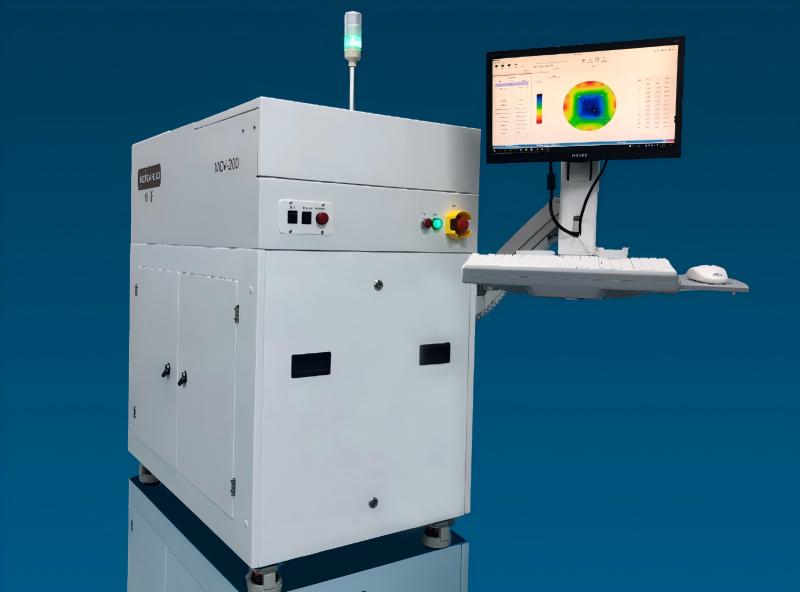
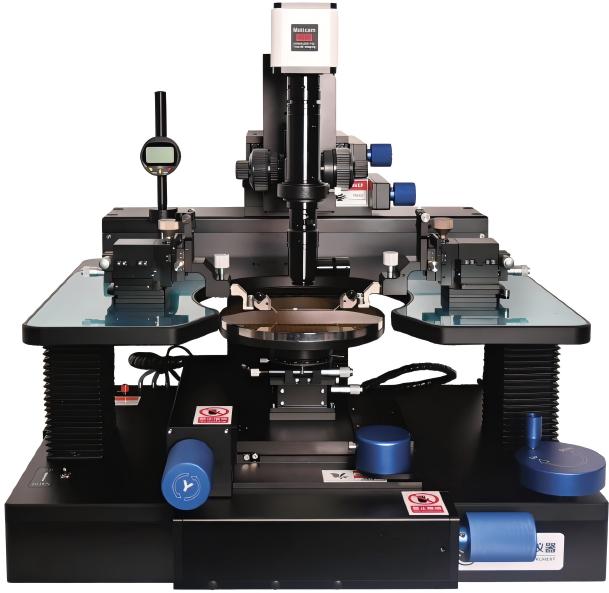
HP-200/300 Hybrid Mercury & Hard Probe CV/IV System
Key Highlights :
- Two models available; H300 is configured with Hard Probes, while H200 is paired with Mercury Probes.
-
Versatility: Supports 2” to 12” wafers and irregular samples.
-
Precision: High-accuracy Carrier Density and Doping Profile analysis.
-
Efficiency: Seamlessly switch between Mercury and Hard probe modes.
- Epi Carrier density, Resistivity/Dielectric film GOI
Product Principles & Overview
H200(Mercury Probe Mode):
Using mercury as a contact electrode to form Schottky contact with semiconductor materials, the
capacitance is tested by applying voltage to calculate the distribution of carrier concentration/
resistivity in the semiconductor material; Alternatively, voltage can be applied to test the current to
characterize various parameters of the dielectric layer quality.
H300(Hard probes mode):
Hard probes use metal probes to test and form ohmic contacts with the metal on the sample surface,
and characterize the electrical quality of the dielectric layer through testing.
Mercury probe and hard probe can be integrated in one system, which can use a set of CV/IV meter
as well as the software and algorith
1. Applicable materials
1.1. Si EPI
1.2. SiC Epi
1.3. GaN Epi
1.4. Ga2O3 Epi
2. Applicable process
2.1. Epitaxy
2.2. Dielectric film
2.3. FPD dielectric film
2.4. Metal pad sample
3. Measurement Parameters
3.1. Epi process
3.1.1. Carrier concentration
3.1.2. Depletion width
3.1.3. Break down voltage
3.1.4. Leakage
3.2. Dielectric film
3.2.1. Flat band voltage
3.2.2. Flat band capacitance
3.2.3. Interface trap density
3.2.4. Threshold voltage
3.2.5. Mobile charge
3.2.6. Fixed charge
3.2.7. EOT
3.2.8. k value
3.2.9. Break down voltage
3.2.10. Leakage
3.3. GaN 2DEG HEMT structure
3.3.1. 2DEG sheet charge
3.3.2. Barrier height
3.3.3. Pinch off voltage
3.3.4. Threshold voltage
3.3.5. Break down voltage
3.3.6. Leakage
4. Hardware configuration
4.1. Mercury probe system
4.1.1. 2/4/6/8 inch wafer, irregular sample
4.1.2. X-theta stage
4.1.3. CV function, IV function (option)
4.2. Hard probe system
4.2.1. 2/4/6/8/12 inch systems,irregular sample
4.2.2. X-Y-Z stage with sample chuck
4.2.3. Microscope
4.2.4. Room temperature wafer stage
4.2.5. RF wafer stage (option)
4.2.6. High voltage wafer stage (option)
4.2.7. Hot chuck wafer stage (option)
4.2.8. High voltage probe (option)
4.2.9. High current probe (option)
4.2.10. CV function
4.2.11. IV function (option)